The Report Every Working Adult Needs to Read — Right Now, In 2026
AI Is Making You
Unemployable
Right Now.
And You
Don't Know It Yet.
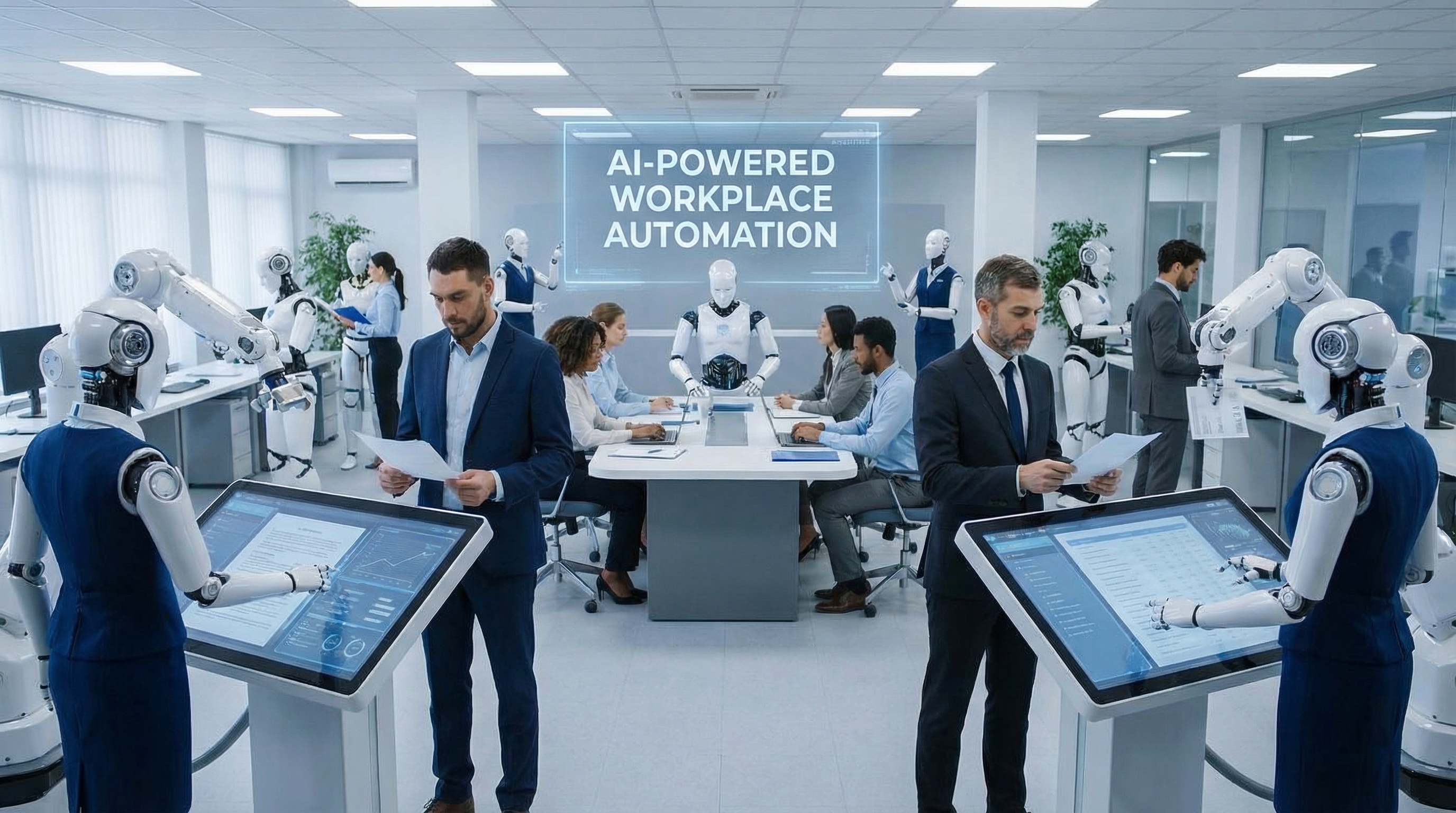
You still have your job. Your salary came in last month. Your manager seems happy with your work. And according to three of the most comprehensive workforce studies ever conducted — by McKinsey, Goldman Sachs, and the World Economic Forum — the skills that got you that job are being automated right now, at a speed that most working adults have not yet registered. This is not a future warning. It is a present-tense emergency. And the window to respond is smaller than you think.
By Future of Work & AI Editorial
·
McKinsey · WEF · Goldman Sachs · MIT · Oxford · March 2026
·
Real data only ✓
🚨
Future of Work & AI Research Editorial
McKINSEY · WEF · GOLDMAN SACHS · MIT SLOAN · OXFORD MARTIN SCHOOL · 2026
⏱ 12 min read
#AIJobs2026
#FutureOfWork
#Automation
#AIReplacing
#SkillsGap
#WorkplaceAI
#ReadNow
#ShareWithEveryone
300M
Jobs Globally Exposed to AI Automation — Goldman Sachs Research 2023-2026. Not "at risk someday." Exposed right now to partial or full AI replacement of their core tasks.
Goldman Sachs Global Investment Research · "The Potentially Large Effects of Artificial Intelligence on Economic Growth" · 2023 · Updated projections 2026 · McKinsey Global Institute workforce automation data · World Economic Forum Future of Jobs Report 2025
Here is what the data says is happening right now, in March 2026, in offices, hospitals, law firms, newsrooms, marketing departments, and accounting firms around the world. The tasks that form the core of millions of white-collar jobs — analysis, summarisation, drafting, coding, research, customer service, basic legal work, financial modelling — are being performed by AI systems faster, cheaper, and at higher volume than any human can match. This is not a projection. It is a present-tense observation confirmed across multiple independent research bodies simultaneously.
The reason most people haven't noticed yet is that job displacement from AI is not primarily happening through mass layoffs. It is happening through headcount freeze — companies are not replacing people who leave. Through scope expansion — one person now does the work that previously required three. Through devaluation — the skills that took years to develop are now worth less because AI can replicate them instantly. Your job title may not change. Your salary may not drop tomorrow. But the floor beneath the value of your skills is moving — and it is moving fast.
NOT SOMEDAY
AI automation of white-collar tasks is not a 2030 projection. Goldman Sachs data from 2026 shows it is happening now — in legal drafting, financial analysis, coding, customer service, content creation, and data research. The companies doing it are not announcing it. They are simply not backfilling positions when people leave.
The Data — What the Reports Actually Say
Three Major Reports Said the Same Thing — And Most People Never Read Them
01
📊 Goldman Sachs · 2023 · Updated 2026
300 Million Jobs Globally Are "Exposed" to AI Automation — Goldman Sachs Called It the Largest Labour Market Disruption Since the Industrial Revolution
📖 Goldman Sachs Global Investment Research · "The Potentially Large Effects of Artificial Intelligence on Economic Growth" · 2023 · 300M jobs exposure estimate · Updated projections 2026
Goldman Sachs economists examined the task composition of occupations across major economies and found that approximately two-thirds of current jobs are exposed to some degree of AI automation. Of these, they estimated that roughly 300 million full-time equivalent jobs globally are exposed to automation — meaning the core tasks of these jobs could be performed by currently available AI systems.
The report was careful to distinguish between "exposed" and "eliminated." Many jobs will be transformed rather than eliminated — with AI handling the automatable tasks and humans focusing on higher-order work. But the transformation requires something most working adults are not doing: actively and rapidly building the skills that AI cannot replicate, while the window for doing so remains open.
The sectors with highest exposure in Goldman's analysis: legal services (44% of tasks automatable), finance (35%), office support (46%), business operations (28%). These are not low-wage repetitive roles. These are the professional, knowledge-worker roles that an entire generation built careers around. The disruption is concentrated precisely where the most people least expected it.
44%
Legal Tasks — Automatable Right Now
Goldman Sachs · Document review, basic drafting, research
85M
Jobs Displaced by 2025 — WEF Predicted in 2020
World Economic Forum · Future of Jobs · On track per 2026 data
97M
New Jobs Created by AI Transformation by 2025
WEF · Net positive — but requires different skills
40%
Working Hours Could Be Affected by LLMs — IMF 2024
International Monetary Fund · Advanced economies hit hardest
02
📈 McKinsey Global Institute · 2023-2026
McKinsey: By 2030, Up to 30% of Hours Worked in the US Economy Could Be Automated. The Speed Has Increased Since Generative AI Arrived.
📖 McKinsey Global Institute · "The Economic Potential of Generative AI" · 2023 · Updated projections 2025-2026
McKinsey's research on generative AI's economic potential, published in 2023, found that generative AI specifically — the type that can produce text, code, images, and analysis — could automate tasks that account for 60-70% of employee time across industries. Their updated 2025 projections accelerated the timeline: what was previously estimated to take until 2030-2035 to deploy at scale is happening 5-10 years earlier than projected, due to the unexpectedly rapid capability growth of large language models.
The McKinsey data identifies the specific skills most at risk: information gathering and processing, communicating and interacting at a basic level, data input and synthesis. And the skills least at risk: physical dexterity in unpredictable environments, emotional and social intelligence, complex reasoning in novel situations, creative ideation, and interdisciplinary synthesis. The divide is not between manual and knowledge work. It is within knowledge work — between tasks that AI can replicate and tasks that require specifically human capabilities.
"The pace of workforce transformation required in the next decade could be three times faster than anything seen in the past. Workers who thrive will be those who learn to work alongside AI — not compete with it, and not ignore it."
— McKinsey Global Institute · The Economic Potential of Generative AI · 2023
THE WINDOW
The people who will benefit most from AI are not those who fear it or those who ignore it — but those who actively learn to work alongside it right now, while the transition is still underway. McKinsey estimates this window of competitive advantage is open now and will begin closing within 3-5 years as AI capability saturates even more of the current skill set.
Your Job — The Real Risk Level
Which Jobs Are Most at Risk — And Which Are Safer Than You Think
📝
Content Writing & Copywriting
🔴 High Risk
Routine content creation, product descriptions, basic articles, social media copy — 90%+ automatable with current LLMs. What survives: deeply personal voice, expert insight, original reporting, relationship-based storytelling.
💼
Data Entry & Basic Analysis
🔴 High Risk
Structured data processing, basic report generation, spreadsheet analysis, routine financial modelling — already being replaced by AI tools in most large organisations. Timeline: largely displaced within 2 years.
🎧
Customer Service (Tier 1-2)
🔴 High Risk
FAQ responses, basic complaint resolution, account queries, order processing — AI handles these interactions better, faster, and at lower cost. Tier 3 complex and emotional service less at risk.
⚖️
Junior Legal Work
🟡 Medium Risk
Document review, basic contract drafting, legal research — heavily automatable. Senior advisory, courtroom advocacy, complex negotiation, client relationship management remain human-dependent.
💻
Entry-Level Coding
🟡 Medium Risk
Boilerplate code generation, bug fixing, documentation, basic feature implementation — AI handles these well. System architecture, complex debugging, and cross-functional technical leadership remain human-critical.
📊
Financial Analysis
🟡 Medium Risk
Standard financial modelling, routine reporting, basic investment screening — AI-accelerated. Complex M&A, client advisory, novel market analysis, and strategic judgement remain differentiated human skills.
🏥
Healthcare (Clinical)
🟢 Lower Risk
Direct patient care, complex diagnosis combining multiple uncertain inputs, surgical procedures, therapeutic relationships — AI assists but does not replace. Administrative and documentation tasks within healthcare are high risk.
🎨
High-Level Creative Direction
🟢 Lower Risk
Strategic creative vision, original concept generation from lived experience, art direction requiring cultural nuance, brand relationships — human-premium. Execution-level creative work is already heavily AI-assisted or replaced.
📊 % of Core Job Tasks Automatable by Current AI — By Sector
Legal Services
44-84% by task complexity
Finance & Insurance
35-70% depending on role level
Software Development
65% of coding tasks AI-assistable
Education
42% — admin higher than teaching
Physical Trade Skills
Lowest exposure — most secure
THE SHIFT
The most in-demand workplace skill of 2026 is not a technical skill. It is "AI fluency" — the ability to work effectively with AI tools, understand their capabilities and limitations, and use them to augment your own performance. Workers who have this skill are more productive than those who don't. Companies are paying more for it. Schools are not yet teaching it at scale.
The Response — What Actually Works
The 6 Skills That Make You More Valuable as AI Gets Stronger — Not Less
🤝
AI Fluency — Working With AI
⏱ Start: This week
The ability to effectively prompt, direct, evaluate, and build on AI outputs. Not programming — collaboration. The workers who will thrive are not those who compete with AI but those who use it as a force multiplier. Someone using AI well is currently 2-4x more productive than someone not using it. That gap is widening every month.
🧠
Complex Problem Solving
⏱ Long-term investment
Novel problems — situations AI has not seen before, ambiguous challenges requiring judgment, decisions with incomplete information and high stakes. AI is excellent at pattern matching on known data. It is poor at genuinely novel situations. The value of human judgment in uncertain, high-stakes contexts increases as AI handles more routine work.
💬
Emotional Intelligence & Leadership
⏱ No AI substitute
Managing people, reading rooms, navigating organisational politics, building trust, mentoring, inspiring teams — AI can simulate these but not perform them. As technical tasks automate, the human skills of leading, motivating, and connecting become more — not less — economically valuable.
🔗
Interdisciplinary Thinking
⏱ Build across disciplines
The ability to connect insights across fields — applying biology to business, psychology to product design, history to strategy. AI is deep within domains. It is poor at genuine cross-domain synthesis. The T-shaped professional with one deep expertise and broad contextual knowledge is currently one of the most AI-resistant profiles in any workforce.
🎯
Original Point of View
⏱ Your unique advantage
AI generates average outputs — statistically common combinations of everything it has seen. It cannot generate a genuinely original point of view rooted in specific lived experience, unique observations, and particular values. Your perspective, built from your specific life, is the one thing AI structurally cannot replicate. Developing and communicating a distinctive POV is increasingly valuable.
⚡
Speed of Adaptation
⏱ Start now
The half-life of specific technical skills is shrinking rapidly. The most durable skill in an AI-accelerating world is the meta-skill of learning quickly — the ability to pick up new tools, enter new domains, and rebuild competence faster than the environment changes. The learner beats the expert in a world where expertise expires faster than it used to.
THE OPPORTUNITY
The WEF projects 97 million new roles by 2025 — more than the 85 million displaced. But these roles require different skills. The transition gap between the skills being eliminated and the skills being created is the central challenge. The people who bridge that gap now, while the window is open, will find themselves in extraordinary demand.
✅ What to Do This Week — Not Someday
The response to AI displacement is not panic and it is not denial. It is specific, practical, and urgent. This week: Spend one hour using an AI tool (ChatGPT, Claude, Gemini) for a task you currently do manually. Notice where it is better than you, and where it fails. That gap is your competitive advantage right now. This month: Identify the 20% of your current job tasks that are highest-value and least automatable — and deliberately do more of them. Reduce time on the tasks AI can replicate. This year: Add one genuinely new capability that crosses domain boundaries — a technical person learning communication, a creative person learning data analysis, a manager learning AI tools. The combination of human and technical skills is currently one of the highest-demand profiles in any sector. The workers who will be fine are not the ones who are irreplaceable today. They are the ones who are continuously building the skills that will be valuable tomorrow. In 2026, that process needs to have already started. If you are reading this, it has.
McKinsey 2023 · Goldman Sachs 2023 · WEF Future of Jobs 2025 · MIT Work of the Future · Oxford Martin School automation research · IMF 2024
The Last Word
The Question Is Not "Will AI Take My Job?" The Question Is "What Am I Doing About It?"
The data is in. Three hundred million jobs are exposed. The timeline is faster than anyone predicted three years ago. The sectors most affected are not the ones that were supposed to be affected first — they are the professional, white-collar, knowledge-worker roles that were supposed to be safe. The warning has been issued, clearly and repeatedly, by the most credible economic research institutions in the world. Most people have not read it. Most people are still acting as if the world of work they entered is the world of work they will retire from.
It is not. The only real question — the only one that matters in 2026 — is what you are going to do about it. Not the government. Not your employer. You. Because the people who will thrive in the AI economy are not the ones who were least affected. They are the ones who saw the shift coming early enough to move toward it rather than away from it. Who learned the tools instead of fearing them. Who built the skills that AI makes more valuable, not less. Who understood that this is not the end of human work — it is the most significant restructuring of what human work means in a hundred years.
The window is open right now. Not forever. Now.
#AIJobs2026
#FutureOfWork
#ActNow
#AISkills
#TheWindowIsOpen
#ShareWithEveryoneYouKnow