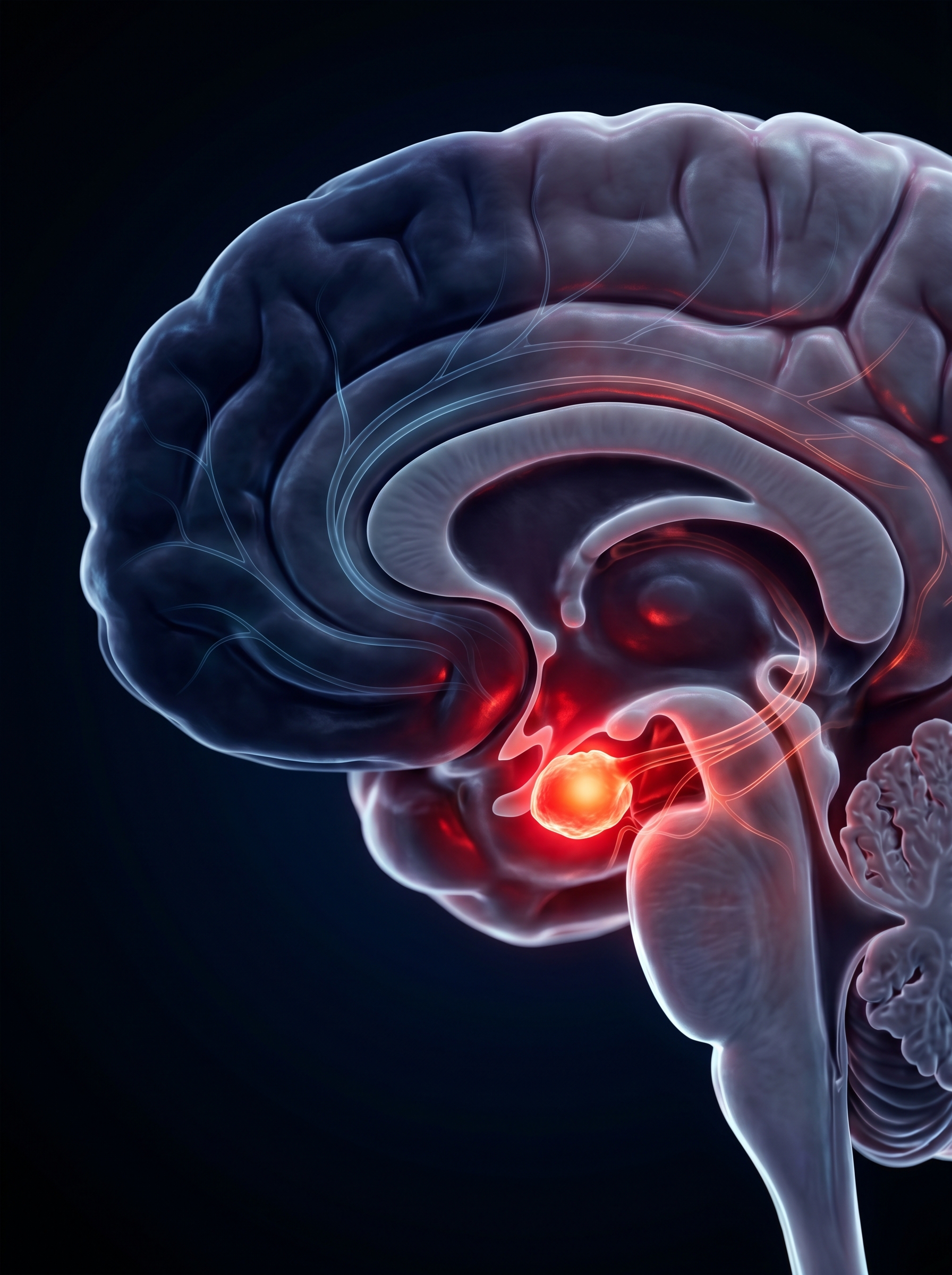
The brain you wake up with is not the brain you have at noon. In the first 90 minutes after waking, your prefrontal cortex — the part responsible for rational thought, accurate assessment, and emotional regulation — is running at significantly reduced capacity. Meanwhile, your amygdala — the ancient threat-detection system — wakes up immediately and begins generating assessments of your life, your problems, and your future that are systematically, measurably, neurologically distorted toward the negative. The morning dread is not you. It is your brain's hardware running a programme it was not designed to run in the modern world.
Cognitive behavioural neuroscience has catalogued specific patterns of thought distortion — called cognitive distortions — that the brain defaults to under conditions of reduced prefrontal activity, elevated cortisol, and incomplete REM sleep. These conditions describe every human being in the first hours after waking. The six lies below are the most common, the most damaging, and the ones most people mistake for accurate assessments of their lives — because they feel true even when they are demonstrably false.
The Neuroscience First
Why Your Brain Is Offline — When You Need It Most
7AM · Mirror · Two Faces · One Real · One Brain-Generated · The Brain's Version · Is Almost Never The Accurate One
🔬 The Morning Brain — What Science Actually Shows
The prefrontal cortex requires approximately 90 minutes after waking to reach full operational capacity — a period neuroscientists call "sleep inertia." During this window, cortisol is at its daily peak (the cortisol awakening response), the amygdala is fully active and threat-scanning, and the rational assessment centres are running below capacity. The result: your brain processes every stimulus — every memory, every plan, every problem — through a filter that magnifies threat, minimises resource, and defaults to catastrophic interpretation. This is not a character flaw. It is neurobiology. But knowing it is neurobiology changes everything about how you respond to it.
The 6 Lies
Each One Named · Each One Documented · Each One Overrideable
The Alarm Is Ordinary · Its Shadow Is Monstrous · Your Brain Made That Shadow · It Is Not Real · It Is 6:30AM Neurology
01
Catastrophising
The Lie: Everything Is About to Go Wrong
"You haven't heard back. They must be angry. The whole thing is falling apart. This always happens to you."
Catastrophising is the brain's tendency to jump immediately to the worst possible interpretation of any ambiguous situation. In the morning cortisol peak, the amygdala treats unanswered messages, pending decisions, and unresolved problems as existential threats. The prefrontal cortex — which would normally interrupt this pattern with probability assessment — is not yet operating at capacity. The catastrophe feels certain. It is almost never certain. Research shows that feared outcomes occur in fewer than 15% of cases where catastrophising predicts them.
Override: Ask one question: "What is the most likely outcome — not the worst possible?" The answer is almost always less catastrophic than the brain's morning version. Write it down. The prefrontal act of writing interrupts the amygdala loop.
02
Negativity Bias Amplified
The Lie: What Went Wrong Is All That Matters
"Yesterday's mistake is the first thing you remember. The three things that went well are invisible."
The human brain is wired to weight negative experiences approximately three times more heavily than positive ones — a documented evolutionary adaptation called negativity bias. In the morning cortisol peak, this bias is amplified further. The brain rehearses yesterday's failures, embarrassments, and mistakes while the positive events receive no comparable replay. The result: a morning assessment of your life that systematically underrepresents what is going well and overrepresents what is not. This is not accuracy. It is biology.
Override: Before reviewing any screen, name three specific things from yesterday that were good — not "fine," specifically good. This is not toxic positivity. It is correcting a documented biological bias toward accuracy.
03
Mind Reading
The Lie: You Know What Everyone Thinks of You
"They think you're incompetent. That interaction yesterday — they definitely noticed. Everyone can see."
Mind reading — the cognitive distortion of assuming you know what others think, particularly negatively — peaks in morning cortisol conditions. The brain constructs elaborate narratives about others' internal states based on minimal evidence, and in the morning, these narratives default to the most threatening interpretation. Research consistently shows that people dramatically overestimate how much others think about them at all — most people's mental bandwidth is occupied by their own concerns, not by monitoring yours.
Override: The spotlight effect is real — you are not at the centre of others' attention the way your morning brain insists. Ask: "What evidence do I actually have for this?" Usually: none. The story is entirely constructed.
04
All-or-Nothing Thinking
The Lie: If It Is Not Perfect, It Has Failed
"The project isn't done yet. Therefore you have failed. You never finish things. This is who you are."
All-or-nothing thinking — the cognitive distortion that eliminates gradations and places everything in binary categories of success or failure — is particularly destructive in the morning because the cortisol-flooded amygdala does not process nuance well. The project that is 80% complete is experienced as incomplete — which the morning brain codes as failure. The relationship that is mostly good but currently difficult is experienced as failing. The partial progress is invisible. The gap from perfect is all that registers.
Override: Replace "is it done?" with "what progress exists?" The 80% complete project represents enormous real achievement. Naming specific progress interrupts the binary assessment and returns the prefrontal cortex to the conversation.
05
Personalisation
The Lie: Everything That Went Wrong Is Your Fault
"The meeting went badly because of you. The relationship is difficult because of something you did. Everything traces back to your failure."
Personalisation is the tendency to assume excessive responsibility for negative outcomes — to see yourself as the primary cause of events that involved many factors. In the morning, this distortion runs particularly strongly because the prefrontal cortex's capacity to distribute causation accurately across multiple factors is reduced. The amygdala is ancient and personal — it filters experience through the lens of self-threat, which makes self-blame the default explanation for anything that feels threatening.
Override: List three factors that contributed to the outcome other than yourself. This is not avoiding responsibility — it is accurate attribution. Most outcomes have multiple causes. Morning brain sees only one.
06
Fortune Telling
The Lie: You Already Know How Today Will Go — And It Will Go Badly
"Today is going to be hard. The conversation will go wrong. You will be tired by afternoon. Nothing will work out."
Fortune telling — predicting future outcomes as certainties, particularly negative ones — is the morning brain's most insidious distortion because it shapes the day before it has occurred. Neuroscience shows that predicted emotional states influence actual emotional states: expecting a bad day activates stress responses that make the day more likely to feel bad. The morning fortune-teller is not predicting — it is creating. The prediction is a self-fulfilling programme. And like all programmes, it can be interrupted.
Override: Replace predictions with intentions. "Today will be hard" becomes "Today, I intend to handle whatever comes with as much steadiness as I can." The shift from prediction to intention moves agency from fortune-telling to action.
"You are not your thoughts. You are the awareness that notices them. The morning mind produces thoughts the way the morning sky produces weather. Your job is not to believe every thought — it is to notice which ones are clouds passing and which are actual reports on actual conditions."
— Adapted from Viktor Frankl · Man's Search for Meaning · Applied to Cognitive Neuroscience · 2026
The Real Morning Protocol
The Fix
What to Actually Do — In the First 90 Minutes
Prefrontal Cortex · Cold · Offline · Amygdala · Hot · Active · This Is Your Brain Before 9AM · This Is Why Morning Feels Like This
30 Minutes · No Phone · No News · Just Present · Let The Prefrontal Cortex Come Online · Before You Ask It To Process The World
The six distortions above share one common feature: they are all produced by a brain whose rational centres are offline and whose threat-detection system is running at full power. The override for all six is the same at the biological level: give the prefrontal cortex something to engage with before the amygdala's narrative becomes your morning's reality.
This is why every documented morning protocol — from ancient philosophical practice to modern cognitive behavioural therapy — begins with deliberate, specific cognitive engagement. Journalling works not because writing is therapeutic in itself, but because it forces prefrontal engagement. Exercise works not only through endorphins but because physical movement shifts cortisol metabolism and draws prefrontal attention away from threat scanning. Cold exposure works not because discomfort is virtuous but because the controlled stress of cold water forces your rational brain to override your reactive brain — and the override skill transfers to the rest of the morning.
The single most effective morning intervention identified in cognitive neuroscience research is simple: delay engaging with any external stimulus — phone, news, email, social media — for the first 30 minutes after waking. The morning brain needs time to come online before it processes external information accurately. Every piece of information received before the prefrontal cortex is operational is processed through the distortion filters above. The information is neutral. The brain is not. Give it time to become so.