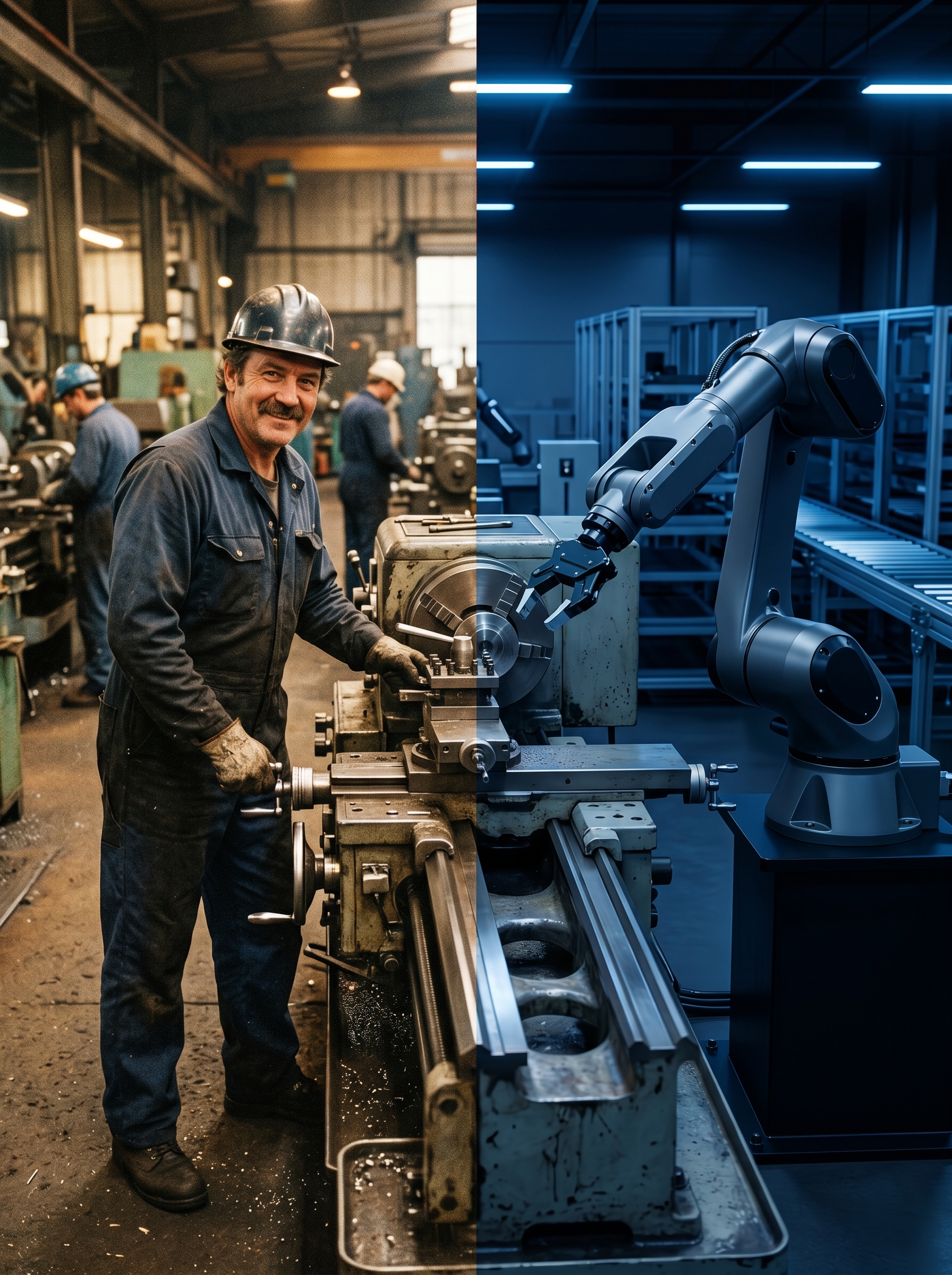
The agricultural revolution freed humanity from hunting. The industrial revolution freed humanity from subsistence farming. The AI revolution is in the process of freeing humanity from compulsory labour — the ten-thousand-year arrangement in which most people spend most of their waking life doing work they did not choose, for someone else's goals, in exchange for the money required to survive. This is the third great liberation. And like the first two, most people will not recognise it as liberation while it is happening to them.
The statistics are not projections anymore. They are measurements. McKinsey estimates 300 million jobs globally will be automated by 2030. Goldman Sachs puts the figure at 300 million full-time equivalent positions affected by generative AI alone — not counting robotics, not counting narrow AI already deployed in logistics, finance, customer service, and legal work. The question being asked in boardrooms, research institutions, and government policy offices around the world is no longer "will AI take jobs?" It is: "what do people do when the jobs are gone?"
Chapter 01 · The Reality
What Is Already Happening — Right Now
The Last Clock-Out · The Building Empties · The Robot Takes The Place · This Is Not 2040 · This Is Now
⚖️
Legal · 2024-2026
AI Lawyers — Replacing $300/Hour Work
Harvey AI is processing legal documents at major law firms. DoNotPay handles consumer legal disputes. Ironclad reviews contracts. Junior legal work — document review, contract analysis, case research — that previously employed thousands of lawyers billing $200-$400 per hour is being performed by AI at a fraction of the cost. Law schools are reporting the lowest application rates in decades.
💊
Medicine · Now
AI Radiologists — More Accurate Than Humans
Google's DeepMind AI detects breast cancer in mammograms with 11.5% fewer false positives and 9.4% fewer false negatives than human radiologists. AI pathology systems diagnose certain cancers from tissue samples with accuracy exceeding the best human specialists. The radiology profession — which took a decade of training to enter — is being restructured in years.
💻
Software · 2025-2026
AI Writes 30% of Code at Major Tech Companies
GitHub Copilot, Claude, and GPT-4 are writing significant portions of production code at Google, Microsoft, and Amazon. Entry-level software engineering — the career path that promised high salaries and job security to millions of graduates — is being automated from the bottom up. Junior developer hiring has dropped measurably across the industry.
📞
Customer Service · Live
1 Million Call Centre Jobs — Already Gone
AI customer service agents handle millions of calls and chats daily at telecoms, banks, and retailers globally. The call centre industry, which employed tens of millions of people globally, is experiencing its fastest contraction since the sector was created. The jobs being lost are not being replaced — they are being eliminated.
Chapter 02 · The Math
300 Million Jobs — The Calculation Nobody Wants to Say Aloud
Same Work · Same Machine · 1970: Human · 2030: Robot · The Progress Nobody Wanted to Name · But Everyone Saw Coming
300M
Jobs Automated by 2030 — Goldman Sachs Estimate
300 million full-time equivalent positions globally affected by generative AI alone — before accounting for robotics, logistics automation, and narrow AI already deployed. To put this in scale: this is larger than the entire workforce of the United States. These are not low-skill jobs exclusively — the most affected categories include legal, financial, administrative, and creative work. The jobs most affected are the ones that paid enough to build a middle-class life.
📊 The Jobs Most at Risk — Verified Data 2026
High risk (60-80% automation potential): Data entry, customer service, basic legal work, routine financial analysis, content moderation, basic coding, administrative coordination, transportation (with autonomous vehicles). Medium risk (30-60%): Accounting, radiography, basic medical diagnosis, paralegal work, junior software development, market research. Lower risk: Complex creative work, emotional care, physical trade skills, senior strategic decision-making, genuine human relationship roles. The pattern is clear: the jobs most at risk are those that pay well enough to rely on but not well enough to be irreplaceable.
Chapter 03 · What Replaces Work
The Post-Labour Economy — What Actually Comes Next
No Clock · No Boss · No Compulsory Labour · Just Purpose · Just Creation · This Is What Comes After · If We Build It Right
"The question is not whether machines will take jobs. The question is whether, when they do, the value they create will be shared with the people whose jobs they took — or captured by the people who own the machines."
— The Central Question of the Post-Labour Economy · 2026
Every previous wave of automation created new jobs to replace the ones it eliminated — but always with a painful transition period, always with winners and losers, and always with the new jobs going to people with different skills than those who lost the old ones. The current wave is different in one critical respect: it is automating cognitive work simultaneously with physical work. There is no obvious "next tier" of human work to move into when both the factory floor and the office floor are being automated simultaneously.
The honest economic answer is that three things will happen simultaneously — and which one dominates will depend on political choices being made right now. New jobs will be created that we cannot currently imagine — this has always happened. Universal Basic Income or equivalent transfer systems will become economically necessary — several countries are already piloting this. And the definition of "work" will expand to include activities that currently have no market value but enormous social value: care work, creative work, community work, and the raising of children.
Chapter 04 · Universal Basic Income
The Policy That Was Considered Radical — Now Inevitable
Not Charity · Not Welfare · Dignity · Given Not Earned By Exhaustion · The Most Political Idea · Made Simple
Universal Basic Income — a regular, unconditional cash payment to every citizen regardless of employment status — was considered a fringe economic idea ten years ago. Today it is being piloted in Finland, Kenya, Canada, the United States, and multiple other jurisdictions. The results are consistent: recipients do not stop working — they work differently. They start businesses, complete education, provide care, and engage in community work. They work less in jobs they hate and more on things that matter.
What This Means For You
Chapter 05 · Your Response
What to Do — While the Transition Is Happening
Build skills that compound across decades, not just years. The skills most resistant to automation are those that require genuine human presence, genuine creativity, and genuine relationship. Not "creative skills" in the abstract — specific skills: the ability to understand what another person needs at an emotional level, the ability to make decisions in genuinely ambiguous situations, the ability to build trust with other human beings over time. These skills compound. A person with twenty years of genuine relationship-building experience is not replaceable by AI.
Build income streams that are not entirely dependent on your time. The transition to a post-labour economy will not happen cleanly — there will be a period, likely 10-20 years, in which traditional employment becomes less stable and less well-compensated while new systems have not fully replaced it. The people who navigate this transition best will be those who have begun building income streams that do not require exchanging time for money directly: digital products, content, invested assets, skills that can be licensed rather than sold by the hour.
Pay attention to the political choices being made right now. Whether the value created by AI automation is broadly shared or narrowly captured is not a technological question — it is a political one. The policies being written now about automation taxation, UBI implementation, and the ownership of AI systems will determine whether the post-labour economy produces the greatest liberation in human history or the greatest concentration of wealth. This is not happening without you — it is happening while you are not paying attention.
Redefine what you mean by "work." The ten-thousand-year equation of work with money has caused enormous damage — to people who do essential unpaid work, to people whose most valuable contributions cannot be monetised, and to the planet, which cannot price its own destruction into market transactions. The post-labour economy offers the first real opportunity to revalue what is genuinely valuable — not just what the market will pay for. Begin that revaluation in your own life before the economy catches up to it.
The generation that navigates this transition with intention will live differently from every generation before it. Not better, not worse — differently. Freed from compulsory labour for the first time in human history, people will face the question that has haunted every philosopher, every spiritual tradition, and every idle mind since thought began: if you did not have to work, what would you do? The answer to that question — not in theory, but in practice — is the project of your life.