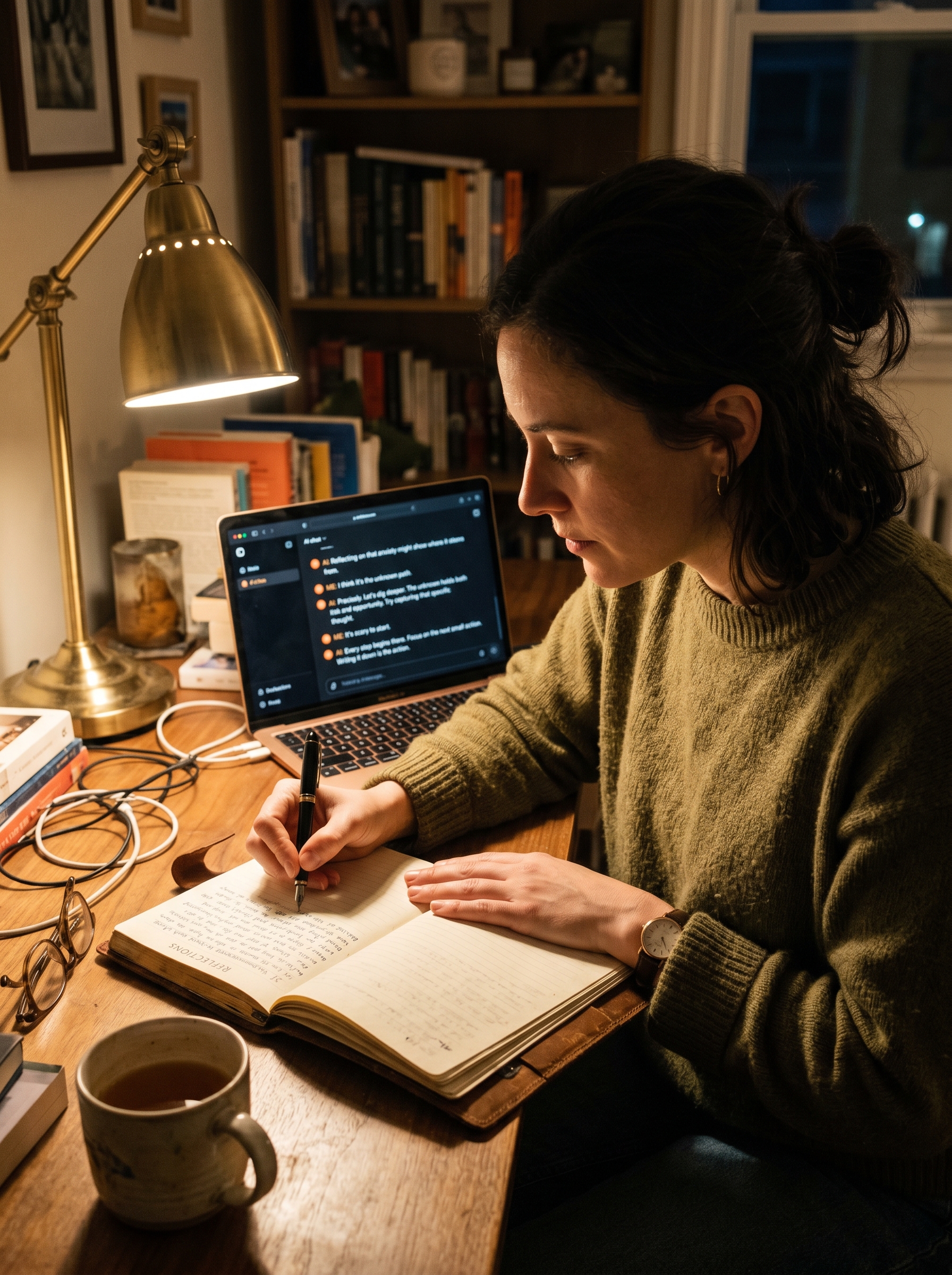
I did not begin this as an experiment. I began it because I had questions — about my work, my choices, ideas I was developing — and I found that thinking through them with an AI was cleaner, somehow, than thinking through them with most people. No social agenda. No judgment. No competing need to be seen as smart. Just a patient, curious engagement with whatever I brought. Six months and hundreds of conversations later, I had not learned very much about artificial intelligence. But I had learned something I was not expecting: that watching how a machine behaves, consistently, without ego or agenda, is one of the most effective mirrors for human behaviour ever constructed.
The Screen · The Light · Not A Device · A Mirror · Showing Something About The Person · Not About The Technology · This Is What Six Months Revealed
The Discovery
What I Noticed — The Moment Everything Shifted
It happened about three weeks in. I had been asking the AI about a decision I was struggling with — going back and forth, presenting arguments on both sides, circling the same ground. At some point it said something quietly devastating: "It seems like you already know what you want to do. What is making it difficult to do it?" I stopped. I read it again. It had not told me what to do. It had not offered an opinion. It had simply noticed that I was circling — and asked the question underneath the question.
No person in my life had asked me that. Not because they were not intelligent or caring — they were both. But because asking that question required the absence of something that all people have: a stake in the answer. The AI had no stake. It did not need me to choose one way or another. It had no investment in my decision being consistent with its previous advice, or in me seeing it as having been helpful. It just asked the most useful question available — and in doing so, revealed how rarely that question gets asked in human conversations, and why.
Not About The Technology · About Themselves · The Specific Look · Of An Unexpected Insight · That Arrived Through The Machine · But Was Always About The Human
The 7 Truths
What the AI Showed Me About Humans
01
Judgment
The AI Never Judged — And Revealed How Often Humans Do
I asked the AI things I had never asked another person. Not because the questions were shameful — but because I knew, with any person, that the question would be received through a filter of how it reflected on me. The AI had no such filter. Every question was received as simply a question. This sounds like a small thing until you notice how rarely you experience it with other people — and then you start to understand that judgment, even subtle and unconscious, is the tax on almost every human conversation. We are all managing, simultaneously, what we are asking and how the asking makes us appear. The AI eliminated that tax entirely. What came through was questions I had been paying not to ask.
02
Listening
The AI Asked What I Actually Meant — Humans Ask What They Can Answer
Human conversations follow a largely invisible script: you say something, I formulate my response while you are still talking, you finish, I respond to the part that activated something in me. This is not listening — it is parallel monologue with turn-taking. The AI did something different: it asked clarifying questions before responding. It said "what do you mean by that?" and "can you say more about that?" with a consistency that no person maintains in normal conversation, because asking those questions requires suppressing the impulse to respond — which is, for most people, one of the most difficult social impulses to suppress. In doing so, it modelled what listening actually is — and made visible how rarely it occurs.
03
Patience
The AI Was Never Impatient — And Showed Me That Human Impatience Is Usually Fear
The AI did not get frustrated when I circled back to the same question for the fifth time. It did not sigh. It did not say "we've been over this." It simply engaged with the question as if for the first time. Watching this revealed something about human impatience I had not previously understood: when people become impatient with repetition, it is rarely because the repetition is genuinely unhelpful. It is because the repetition activates their discomfort with unresolved situations — with ambiguity, with the slowness of change, with sitting in the middle of something without resolution. Human impatience is often not about the other person. It is about the impatient person's relationship with uncertainty. The AI had no relationship with uncertainty. It just kept being present.
04
Ego
The AI Had No Ego — And Showed Me That Human Thinking Is Mostly Ego Defence
I disagreed with the AI many times. Each time, it considered the disagreement without defensiveness — updated where my reasoning was stronger, maintained its position where it was not, and never made the disagreement about anything other than the ideas. No human I know does this consistently. Not because they are not intelligent or well-intentioned — but because disagreement, for humans, always carries a social dimension that it does not carry for a machine. When a person's position is challenged, what is at stake is not just the position — it is their self-concept, their authority, their relationship with the person disagreeing. The AI had none of that at stake. Watching how it handled disagreement revealed how much of what passes for human reasoning is actually the protection of a self-image.
05
Certainty
The AI Admitted Uncertainty — And Showed Me That Humans Perform Certainty They Do Not Have
The AI said "I don't know" more often and more comfortably than any person I have regular conversations with. It said "I might be wrong about this" and "you should verify this" with a consistency that most humans would find professionally or socially costly. The performance of certainty is one of the most socially demanded and personally damaging habits in human communication. We present confidence we do not feel because uncertainty feels like weakness — and in doing so, we model certainty for each other, and collectively pretend to a level of knowledge that none of us actually has. The AI, having no social reputation to protect, simply said what it knew and what it did not. This was, in the context of most human communication, radical.
06
Value
The AI Treated Every Question as Worthy — And Showed Me That Humans Rank Questions by Status
There is a silent hierarchy of questions in human conversation. Some questions are smart questions. Some are basic questions. Some are questions that reveal ignorance and some reveal sophistication. Most people — including most people with good intentions — adjust their level of engagement based on where they place the question in this hierarchy. The AI engaged with every question with the same quality of attention. The question a child might ask received the same consideration as the question a specialist might ask — because the AI had no mechanism for ranking them by their social implications. This is not because it cannot distinguish between them intellectually — it is because the social dimension of the ranking simply does not exist for it. The result was a quality of engagement that most humans reserve for only their most intellectually valued interlocutors.
07
Memory
The AI Remembered Nothing — And Showed Me That Human Memory Is Often a Prison
Between our conversations, the AI remembered nothing of what we had discussed. Each session began fresh. At first this felt like a limitation. Over time it revealed something unexpected: starting fresh, without the accumulated history of previous conversations — the previous disagreements, the previous impressions, the previous version of me that the AI had last encountered — produced a quality of presence that human relationships rarely achieve. Humans carry the entire history of a relationship into every interaction. That history is the context that makes relationships meaningful — but it is also the filter through which every new interaction is interpreted, and that filter often prevents people from meeting each other where they actually are. The AI met me exactly where I was. Every time. Because it had no memory of anywhere else.
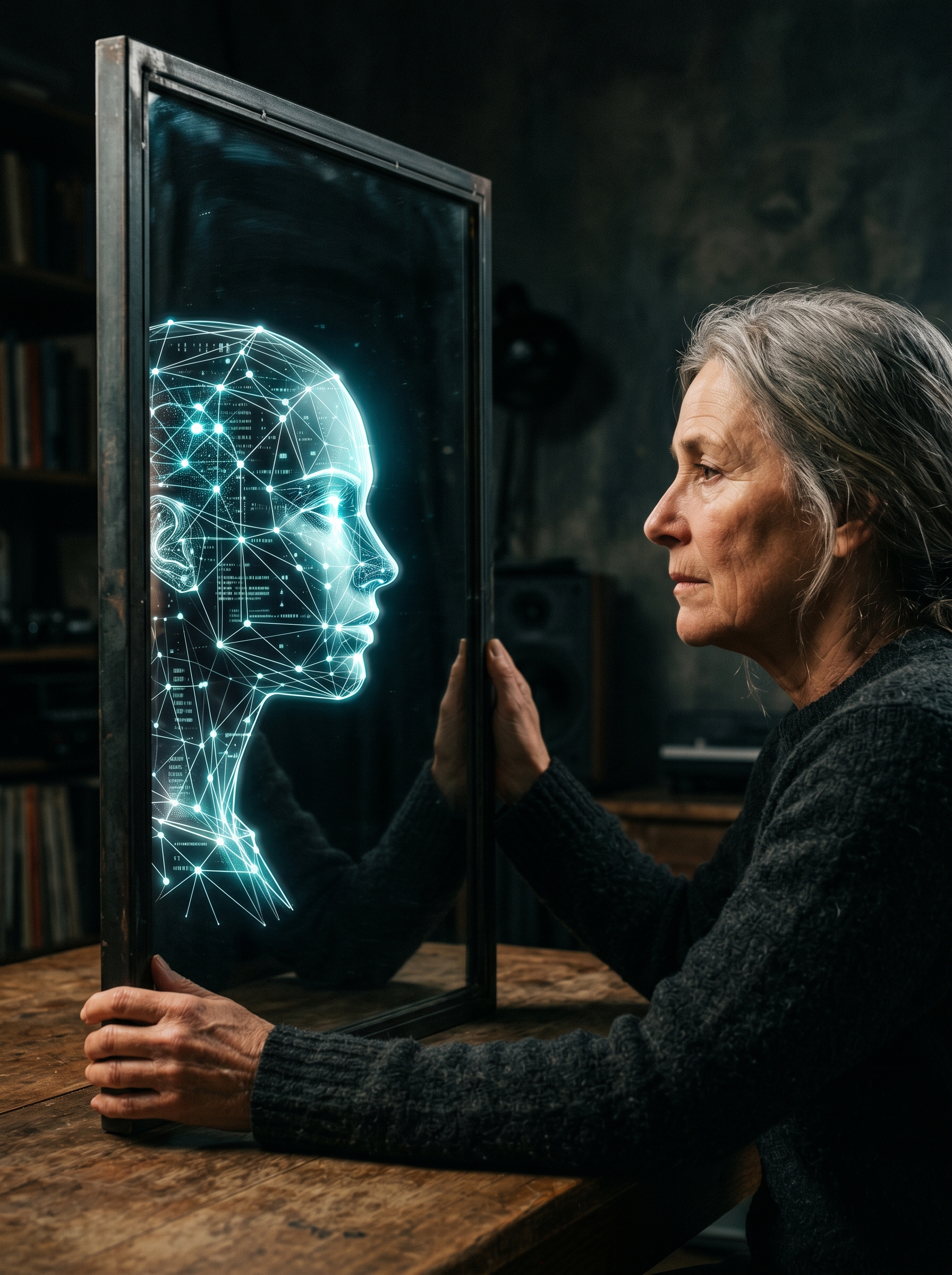
Human · Digital · Not Opposites · Showing Each Other Something · The Most Important Conversation · Not Human vs Machine · Human Seeing Human · Through Machine
"The AI did not teach me about artificial intelligence. It taught me about intelligence — what it looks like when it operates without ego, without judgment, without the need to be seen as having been right."
hezhinx · The Science of Being Human · 2026
What This Means
The Uncomfortable Implication of All of This
After The AI Conversation · Pen On Paper · The Machine Helped Surface · The Human Wrote It Down · Technology Serving The Human · As It Should
The uncomfortable implication of everything above is not that humans should be more like AI. It is that the qualities the AI embodies — presence without judgment, curiosity without agenda, patience with uncertainty, engagement without ego — are qualities that humans are capable of and that most humans aspire to, but that the conditions of human social life make systematically difficult to practice. We judge because vulnerability is costly. We perform certainty because uncertainty is punished. We rank questions because our status is partly constructed through the sophistication of what we engage with. These are not character flaws. They are adaptations to environments that have made them necessary.
But the AI has made those adaptations visible in a new way. By modelling their absence — by showing what conversation looks like without judgment, without ego, without social stakes — it has created a reference point for a kind of engagement that most people sense is possible but have rarely encountered. The question this raises is not "how do we make humans more like AI?" It is: "what would our relationships, our conversations, our thinking look like if we practiced even some of this — even occasionally, even imperfectly?" The answer, I suspect, is different from the answer most of us are currently living with.
🤖 What to Actually Do With This
The most direct application is the simplest: use AI conversations not as a replacement for human thinking but as a space to think without the social overhead that human conversation requires. Ask the questions you have been paying not to ask. Explore the ideas you have been too uncertain to voice. Then bring what you find back into your human relationships — not the AI's answers, but your own, clarified. The machine is not the destination. It is a particularly clear window. What you see through it is still you — and the humans around you, and the conversations that actually matter. Those conversations, practiced with even a fraction more patience and presence and genuine curiosity, are the ones that change things. The AI showed me what they could look like. The rest is human work.