Every January, the World Economic Forum puts the same question to 1,300 of the most consequential people on earth — central bankers, heads of state, military planners, climate scientists, technology executives. What are you most afraid of? This year, for the first time in a decade, the answer was not a pandemic, not a natural disaster, not even nuclear conflict. It was something that most people do not yet have a word for — and that silence is part of the problem. Here is what the people who run the world are quietly losing sleep over.
The World Economic Forum's annual gathering in Davos, January 2026 — where 1,300 experts ranked geoeconomic confrontation as the number one global crisis risk for the first time in a decade.
Risk 01
01
2026–2028 · Ranked #1 — WEF Global Risks Report 2026
Economic war is already here — and most governments built no defence for it
#1Geoeconomic confrontation — top global risk 2026, up 8 positions from last year
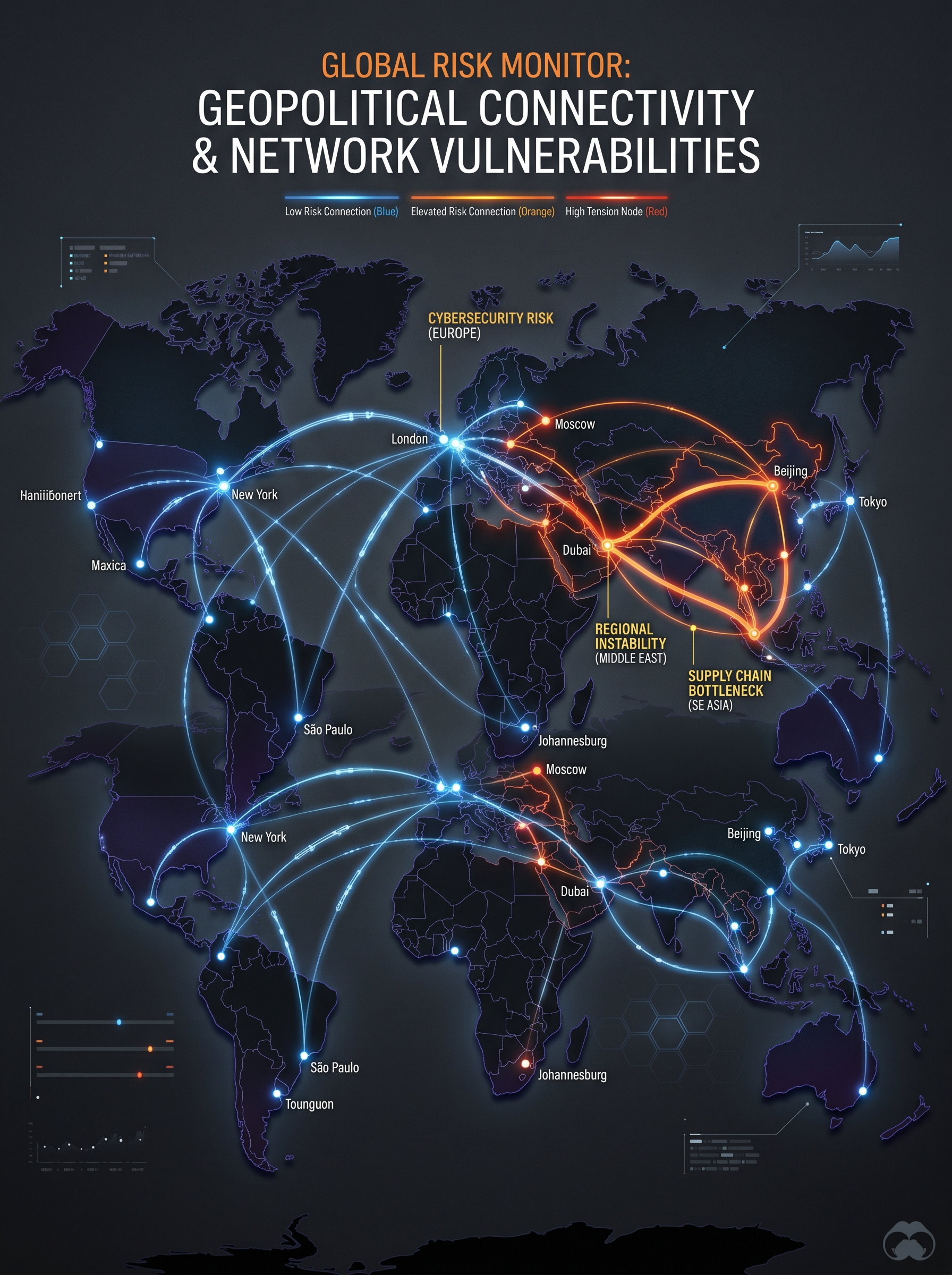
There is a war being fought right now that does not appear in casualty counts. Its weapons are tariffs, export controls, sanctions lists, capital restrictions, and the deliberate severing of supply chains that took forty years to build. Geoeconomic confrontation — the use of economic instruments as strategic weapons — has jumped eight positions to become the single risk most likely to trigger a global crisis in 2026, according to the WEF's survey of 1,300 global leaders and risk experts.
What makes this moment different from past trade disputes is scope. The Strait of Hormuz blockade is the most visible front. But the same logic is playing out in semiconductor export controls, rare earth mineral restrictions, the fragmentation of global payment systems, and the quiet rewriting of investment screening rules in thirty-plus countries simultaneously. These are not tariffs applied at a border. They are the architecture of a parallel global economy being built in real time — one where the rules of trade, finance, and technology access are determined by strategic competition rather than shared norms.
18%of experts named it the single risk most likely to trigger a global crisis this year
Risk 02
02
2026–2030 · Ranked #2 two-year outlook — WEF 2026
The information system is fracturing — and the institutions built to fix it are losing ground
#2Misinformation and disinformation — two-year global risk outlook
Misinformation and disinformation ranked second in the WEF's two-year outlook. It keeps rising because the asymmetry between production and correction keeps widening. Generating convincing false content — at scale, in multiple languages, with photorealistic visual support — now costs almost nothing and takes seconds. Correcting it requires institutional credibility, speed, and reach that the organisations historically responsible for that job — mainstream media, government communications, peer-reviewed science — are losing faster than they are being rebuilt.
The deeper problem is structural. When American leadership becomes more selective and transactional — one of the four structural trends identified by the NYU-Wikistrat project across 105 analysts from 22 countries — the vacuum it leaves in global information governance does not stay empty. It fills with competing narratives from actors who have no interest in accuracy and considerable interest in confusion. Shared reality, which is the precondition for any collective response to any global problem, becomes something that cannot be assumed.
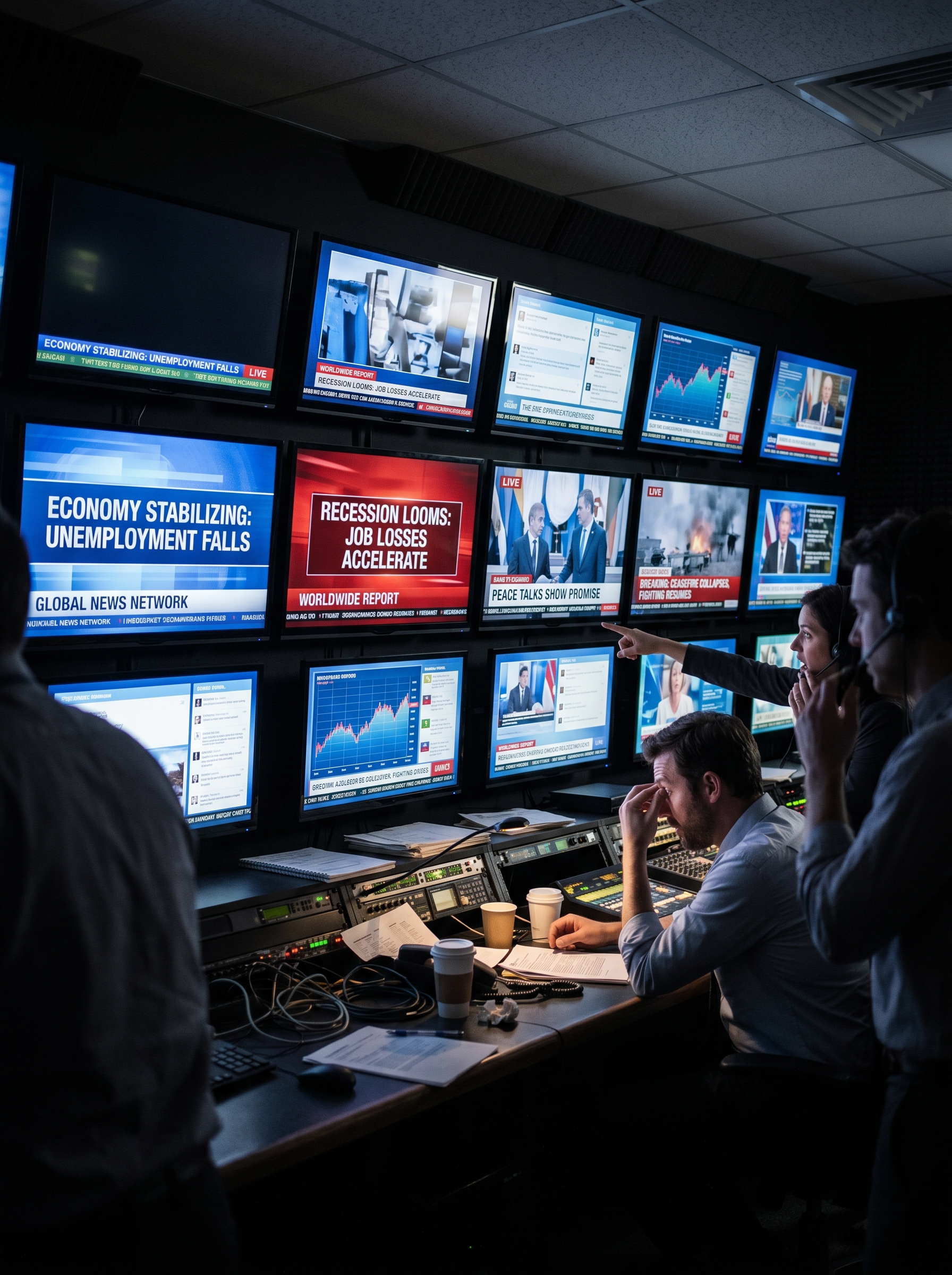
The cost of generating convincing false content has fallen to near zero. The cost of correcting it — in credibility, time, and institutional trust — keeps rising. That gap is what makes misinformation a structural risk, not a temporary problem.
"Half of the 1,300 experts and leaders surveyed expect the world to be turbulent or stormy over the next two years — up sharply from last year. Only 1% anticipate calm."
— WEF Global Risks Report 2026 · January 14, 2026
Risk 03
03
2026–2030 · Ranked #3 short-term — WEF 2026
Societies are pulling apart at a speed that institutions cannot match
#3Societal polarisation — top short-term risk 2026
Societal polarisation sits at number three and the mechanism driving it is not difficult to follow. Economic inequality produces grievance. Grievance finds its most efficient expression in political identity. Political identity hardens into tribal loyalty that actively resists contradictory evidence. The content systems that most people now use as their primary window onto the world are optimised for engagement — and engagement peaks when people are angry, afraid, or confirmed in their existing beliefs. The cycle feeds itself faster than any institution can interrupt it.
What the 2026 data adds is a geographic dimension that most domestic-focused analysis misses. The countries absorbing the sharpest effects of trade disruption, supply chain fragmentation, and AI-driven job displacement are not the same countries designing the rules of those transformations. That asymmetry — between who shapes the forces and who bears their consequences — is the international driver of polarisation. It does not replace the domestic version. It compounds it.
Risk 04
04
2026–2035 · Fastest-rising risk category — WEF 2026
AI anxiety has crossed from a technology concern into a geopolitical one
Top 10First time "adverse outcomes of AI" entered WEF global risk rankings
Adverse outcomes of AI technologies entered the WEF top 10 for the first time this year, alongside cyber insecurity. What shifted is not the capability of the technology — it is the scale and depth of its deployment. AI now participates in hiring decisions, credit assessments, medical triage, military targeting, and the content systems that determine what billions of people encounter as news. The speed at which consequential decisions are being made by systems that cannot explain their own reasoning has crossed a threshold that the people closest to those systems find genuinely alarming.
Three powers — the United States, China, and the European Union — are writing the rules of AI development for the rest of the world, with no agreed framework for doing so and no mechanism by which the remaining 150-plus countries have meaningful input. The communities that bear the most severe consequences of AI deployment — in labour markets, in access to credit and healthcare, in exposure to automated surveillance — are largely the communities furthest from the rooms where the decisions are made.
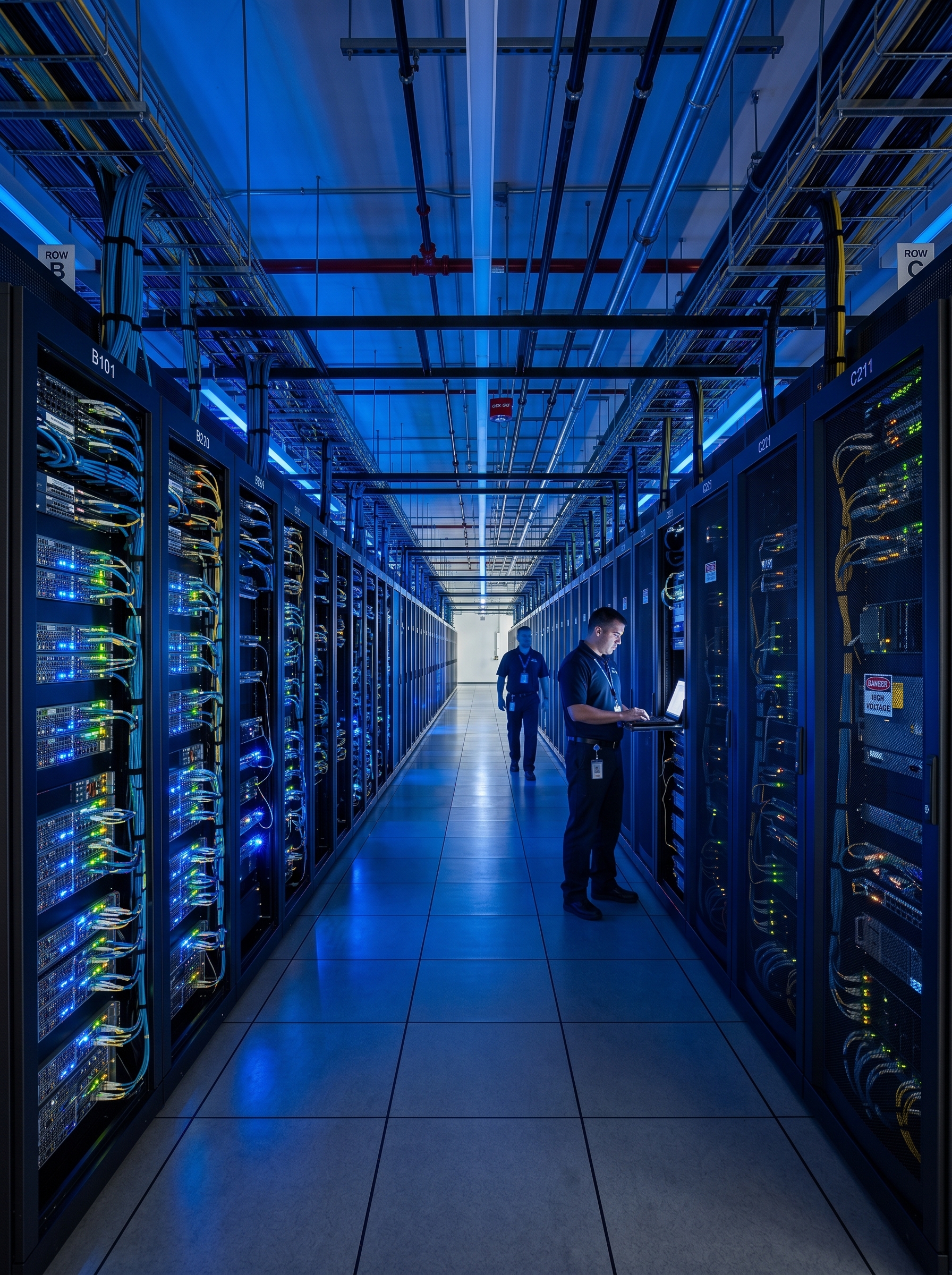
The physical infrastructure of AI governance — data centers consuming more electricity than some mid-sized nations, controlled by a handful of corporations operating across a patchwork of incompatible regulatory frameworks. The 2026 WEF report flags this concentration as a systemic risk.
Risk 05
05
10-year outlook · #1, #2, #3 — WEF long-term rankings
Climate risk is being crowded out — and that is itself the most dangerous development of 2026
#1Extreme weather — most severe long-term risk, 10-year horizon
Looking ten years out, environmental threats dominate the risk landscape entirely. Extreme weather events, biodiversity loss, ecosystem collapse, and critical changes to Earth's systems occupy the top three positions. The same 1,300 experts who ranked geoeconomic confrontation as their most urgent current concern ranked planetary destabilisation as the defining story of the decade. These are not two different groups of people reaching different conclusions. They are the same people holding both realities simultaneously — and finding it very hard to act on both at once.
That difficulty is itself the most dangerous development in climate governance in 2026. Climate action requires sustained, coordinated attention from governments currently consumed by trade wars, AI regulation, social fracture, and active military conflicts. The physical system does not pause while the political system catches up. Every month of crisis management is a month of climate governance that does not happen. The gap between what the science requires and what politics can currently deliver is not a static distance — it compounds.
2030swindow when key climate tipping points reach their most vulnerable phase
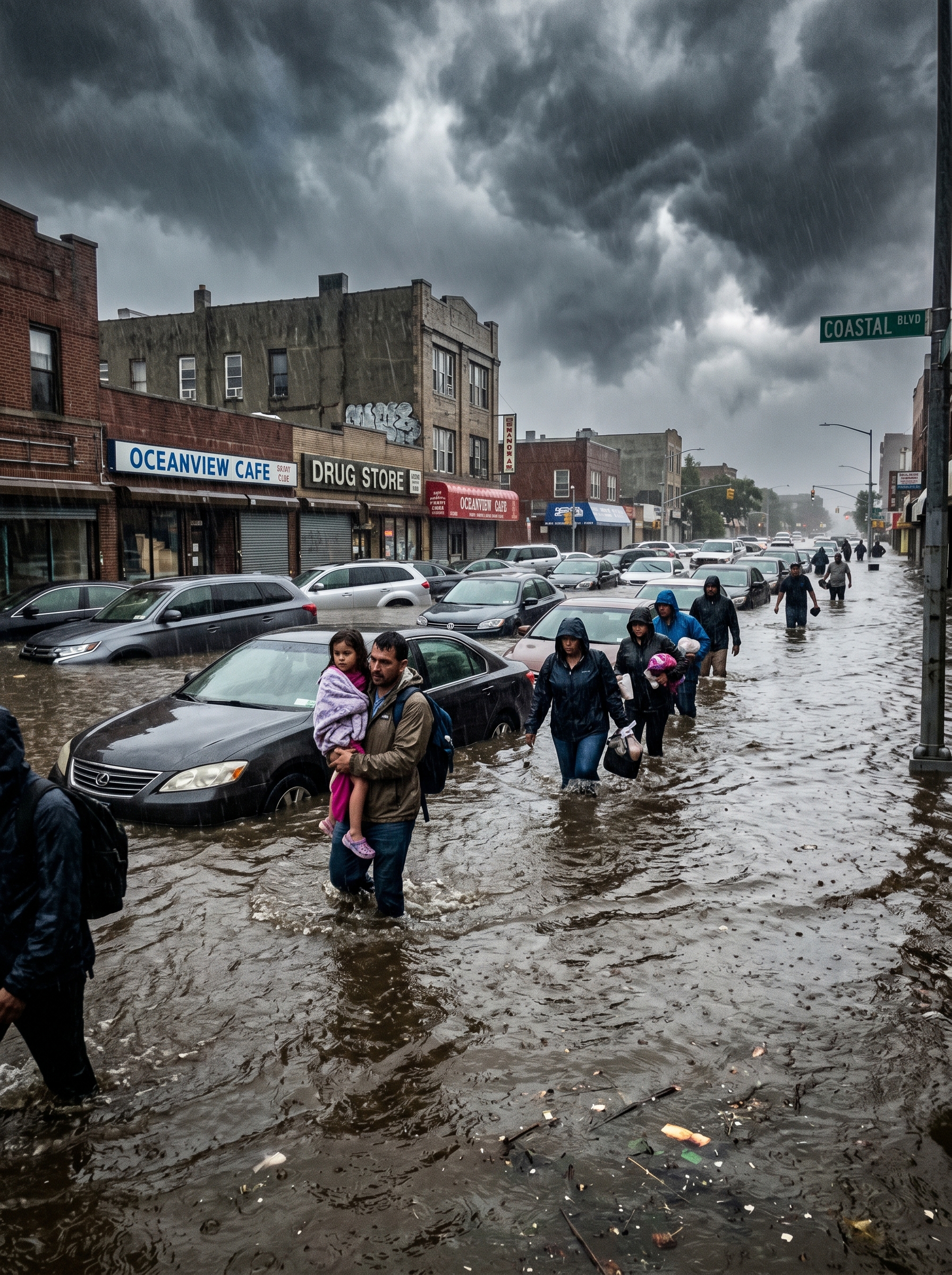
Extreme weather ranked as the most severe long-term global risk in the WEF's ten-year outlook — above geopolitical conflict, above AI, above every other category. The physical system does not wait for the political one to be ready.
Risk 06
06
2027–2030 · Economic reckoning window — WEF 2026
The debt structure built during the low-rate era was never designed for this environment
+8positions — economic downturn surged in severity in WEF 2026 rankings
Economic downturn recorded one of the largest increases in severity score in this year's WEF report. The logic is not complicated. Sovereign borrowers, corporations, and households extended themselves during a decade of near-zero interest rates, on the assumption that rates would stay low or fall. They did not. The capital demands of the AI buildout are now competing directly with social spending in every major government budget. Debt sustainability is deteriorating in countries that lack the fiscal space to absorb either the investment required to adapt or the cost of not adapting.
The NYU-Wikistrat analysts flagged a specific scenario that mainstream forecasters are reluctant to model: simultaneous debt stress in multiple middle-income countries, triggered not by any single domestic failure but by the cascading effect of geoeconomic confrontation on trade revenue, currency reserves, and access to capital markets. The countries most exposed are exactly those with the least capacity to absorb external shocks. They contain roughly three billion people.
"Geoeconomic confrontation is already spreading well beyond tariffs — encompassing sanctions, capital restrictions, and the deliberate weaponisation of supply chains as instruments of strategic competition. The existing rules-based order was not designed to contain any of this."
— WEF Global Risks Report 2026 · Chapter 2
The window that matters
Now — 2026
Economic war at scale. Hormuz, semiconductors, capital controls. The geoeconomic confrontation the WEF warned about is not a forecast — it is the current condition.
2027
Debt stress peaks. Variable-rate borrowers face their reckoning. AI infrastructure spending competes with welfare spending in every major budget simultaneously.
2028
AI governance inflection. Systems embedded in critical decisions without agreed accountability frameworks. First major AI-attributed geopolitical incident becomes probable.
2029–2030
Climate tipping point window. Amazon, Arctic permafrost, AMOC — the systems under stress reach their most critical phase. Political bandwidth to respond is at a historic low.
Six risks. Four years. One converging timeline — from economic war and information fracture in 2026, through debt stress and AI governance crisis in 2028, to the climate tipping point window opening at the end of the decade.
The 1,300 people who answered this survey are not pessimists. Pessimists do not run central banks or lead climate research institutions or advise governments on military risk. They are people whose jobs require them to be accurate. When half of them describe the next two years as turbulent to stormy, and only one in a hundred anticipates calm, that is not sentiment. It is a reading. The risks in this piece are not warnings about things that might happen. They are descriptions of forces already in motion — visible in shipping lanes, in election results, in temperature records, in sovereign balance sheets, and in the widening distance between what the moment requires and what governments are currently capable of delivering. Seeing them clearly is not the same as being helpless before them. It is the only place to start.