There is a question that every human being carries, mostly in silence, from the moment they become aware enough to carry it: what happens at the end? Not after — not the metaphysical question about what comes next — but at the end itself. In the final moments. In the last seconds of the last experience a human consciousness will ever have. Science has begun, carefully and with appropriate humility, to answer this question. And what it has found changes how you understand not just death — but everything that comes before it.
The Threshold · Not An Ending · A Completing · Every Dusk Is Practice For This · Every Horizon Has Been Pointing Here · Your Brain Has Known All Along
The Science
What the Brain Actually Does In the Final Moments
For most of human history, death was understood as the brain switching off. Like a light. Like a machine powering down. The neuroscience of the last two decades has revealed something that contradicts this model so completely that the field is still processing its implications: in the final moments of life, the brain does not power down. It powers up. EEG recordings taken at the moment of cardiac arrest — the closest measurable proxy to the moment of death — show a surge of coordinated neural activity, at frequencies and amplitudes that exceed anything recorded during waking consciousness. The dying brain is, by measurable electrical activity, more alive than it has ever been.
A landmark 2023 study published in the Proceedings of the National Academy of Sciences recorded two dying patients whose cardiac monitors were accidentally left on in the final hours of their lives. Both showed surges of gamma wave activity — the highest-frequency brain waves, associated with conscious awareness, memory recall, and the integration of information — at the precise moment of death. The specific regions that activated were the same regions implicated in dreaming, in memory consolidation, in the experience of self. The brain, in its final moment, appears to be doing something deliberate. Something that has the signature of an experience, not a malfunction.
Six Documented Phenomena
What Happens — Verified and Named
The Corridor · Each Door · A Memory · Each Room · Something That Mattered · The Life Review · Is Not Metaphor · It Is Neuroscience · With A Name
🎬 The Life Review
The Brain Plays Your Entire Life — At Once — In Seconds
The life review — the experience of seeing one's entire life flash before one's eyes — is one of the most consistently reported features of near-death experiences across cultures, ages, and belief systems. It has been documented in survivors of cardiac arrest, drowning, falls, and acute medical crises on every continent since systematic collection began in the 1970s. The neuroscientific explanation has now been substantially developed: the hippocampus — the brain's memory storage and retrieval system — undergoes hyperstimulation in the oxygen-deprived dying brain, releasing stored memories in an uncontrolled cascade. But this explanation does not account for the most consistently reported feature of the life review: it is not experienced as a random cascade. It is experienced as a coherent, meaningful narrative. A review, not a flood. The brain, in its final surge, appears to be organising memory into something that feels like understanding.
⏱️ Time Dilation
The Last Seconds Feel Like Hours — The Brain Creates Its Own Time
Time perception in the dying brain undergoes a documented distortion that runs counter to what you would expect from a failing system. Survivors of near-death events consistently report that what occurred in seconds — a cardiac arrest lasting 30 seconds, a fall lasting 2 seconds — was experienced as lasting minutes or hours. The neuroscience of this is grounded in the relationship between neural firing rate and time perception: when neural activity increases, time subjectively slows. The dying brain's surge in electrical activity produces a subjective time dilation that may mean the final moments of consciousness are experienced as far longer — far richer — than their objective duration. The last seconds are not abbreviated. They may be the longest seconds of a life.
🧪 DMT Release
The Brain Releases Its Most Profound Chemical — At the End
Dimethyltryptamine — DMT — is an endogenous psychedelic compound produced naturally in the human brain. Its role in normal waking consciousness is debated, but its presence in the brain at the time of death is documented. Research published in Frontiers in Neuroscience found elevated DMT levels in rat brains at cardiac arrest — and the similarities between the phenomenology of DMT experiences and near-death experiences have been noted by researchers since the 1990s. The features that overlap: encounters with light, the experience of leaving the body, the sense of a vast and encompassing presence, the feeling of profound understanding. The brain appears to possess an endogenous compound whose primary observable effect is the production of the specific experience that the most reliable accounts of dying describe. Whether this is coincidence or function remains one of the most significant open questions in neuroscience.
✨ Terminal Lucidity
People with Advanced Dementia Speak Clearly — Hours Before Death
Terminal lucidity is one of the most documented and least explicable phenomena in end-of-life medicine. Patients with advanced Alzheimer's disease — patients who have not recognised family members or spoken coherently in years — regain full clarity of consciousness, identity, and speech in the hours before death. They recognise their loved ones. They say goodbye. They speak in full sentences. They are, in those final hours, entirely themselves. And then they die. The neurological mechanism is not understood. The disease has not reversed. The plaques and tangles that destroyed their cognition are still there. Something in the dying process — the surge of electrical activity, the hormonal cascade, something not yet mapped — temporarily restores access to the self that the disease had buried. Terminal lucidity suggests that the person was never entirely gone. That consciousness, even heavily damaged, persists in forms that are inaccessible until the dying process, somehow, releases them.
🌐 The Default Mode Network
The Brain's "Self Network" Becomes Fully Active — For the First Time
The default mode network — a set of interconnected brain regions that activate during self-reflection, mind-wandering, and the construction of the sense of self — shows heightened activation at the time of death. This is the network most associated with the experience of being a self: with continuity, with narrative identity, with the feeling of being the same person who woke up this morning and went to sleep last night. In normal waking life, this network is frequently suppressed — by task demands, by attention, by the constant processing of external information. At the moment of death, when external processing has ceased, the default mode network appears to activate without competition for the first time — producing the most unobstructed experience of self that any human being will ever have. The brain, at the end, finally has the space to meet itself fully.
❓ Consciousness
Where It Goes — The Question Science Is Honest Enough to Leave Open
The most important thing that neuroscience has to say about consciousness after death is also the most uncomfortable: it does not know. The hard problem of consciousness — how physical processes in the brain produce subjective experience — remains unsolved. We do not know what consciousness is. We do not know what generates it. We do not know whether it is produced by the brain or merely mediated by it. The honest position of the most rigorous researchers is that the question of what happens to consciousness after the brain ceases to function is genuinely open — not because the evidence points to any particular answer, but because we do not yet understand consciousness well enough to know what evidence would be relevant. What the neuroscience of dying has established is that consciousness persists longer into the dying process than anyone expected — and that what it experiences in those final moments is, by the accounts of those who returned from its edges, not what anyone feared it would be.
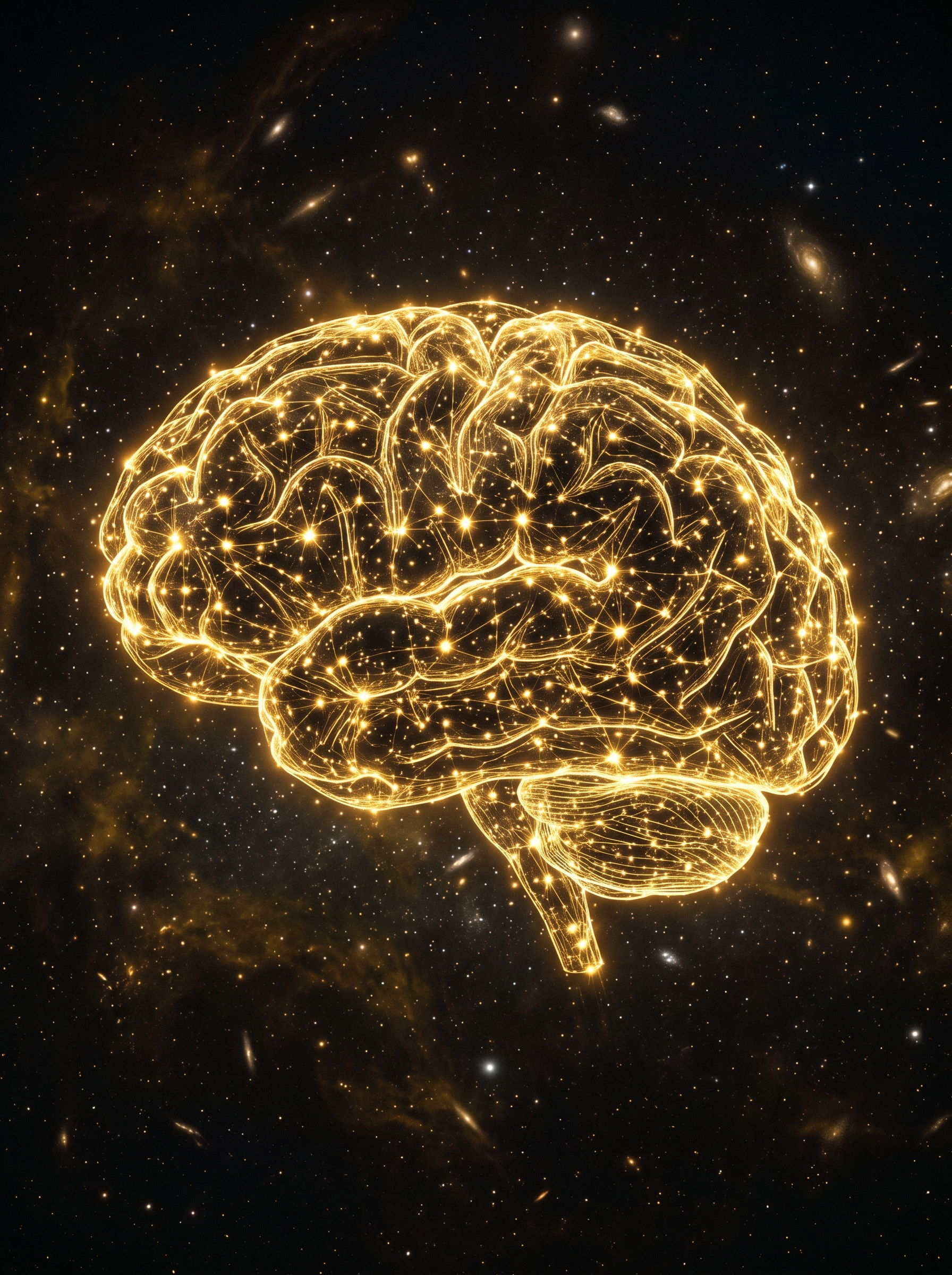
Every Connection · Lit · Simultaneously · The Brain At Full Capacity · For The First Time · Meeting Itself · Completely · This Is What The Science Shows Happens · At The End
"The dying brain is not powering down. It is completing. And what it completes — the final integrated experience of a consciousness that has spent a lifetime accumulating material — may be the most significant experience available to a human being."
hezhinx · The Science of Being Human · 2026
The Preparation
Why Your Entire Life Has Been Building Toward This
Small Source · Infinite Reach · Consciousness Is This · One Flame · In Complete Darkness · Producing Light · Disproportionate To Its Size · Until It Doesn't
The life review — the brain's final organised cascade of memory — draws on everything that was experienced and stored during the life that preceded it. Every meaningful moment you have experienced has been stored in the hippocampus and the cortical networks surrounding it. Every face you loved. Every choice you agonised over. Every moment of genuine connection, genuine beauty, genuine fear, genuine joy. The final surge of neural activity that characterises the dying brain accesses all of it. Organises it. Experiences it.
This means something profound about the life you are living right now. Every moment of genuine presence — every time you were fully there, not half-distracted, not managing how you appeared, just actually present with the person or the place or the experience in front of you — is being stored. Every moment of authentic connection. Every experience of beauty you actually stopped for. Every act of courage, however small, that cost you something real. All of it is being filed. All of it will be available. The brain is building your life review right now — in every moment of genuine living — and the material it has to work with is the material you are giving it.
The near-death accounts that researchers have collected across fifty years of systematic study share a feature that is not discussed as often as the light or the tunnel or the life review: the emotional tone. The most consistent report across cultures, ages, belief systems, and circumstances is not terror. It is not pain. It is — with a consistency that statisticians would find remarkable if it described almost any other phenomenon — a sense of profound peace, of being understood completely, of something that most accounts reach for the word "love" to describe, though most of the people who report it say the word is inadequate. The dying brain, in its final surge, with access to every moment of a life, appears to produce something that the most comprehensive survey of near-death accounts describes as the most positive experience available to a human consciousness.
This does not resolve the question of what comes after. It does not answer the metaphysical questions that all honest people carry. But it does answer a different question — the one that most people are actually asking when they ask about death: will it be terrible? And the neuroscience, careful and provisional and honest about what it does not know, suggests an answer that is not what fear would predict. The brain, in its final moments, does not appear to experience abandonment. It appears to experience completion.