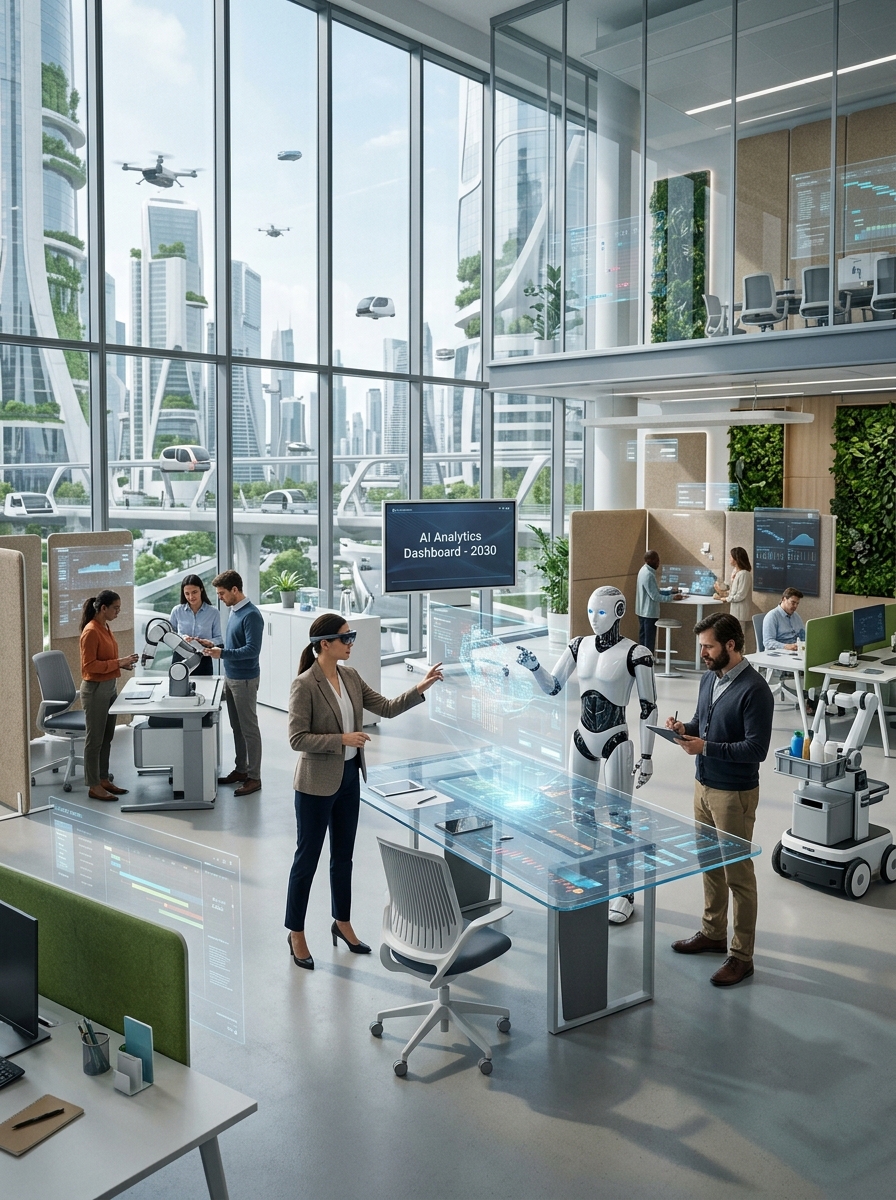
Nobody has a perfect map of the future. But some people get closer than others — and right now, the researchers at WEF, Stanford, and UCLA are converging on a picture of the next four years that most people are not prepared for. Not because it is secret. Because it is uncomfortable to sit with. What follows is what the data actually says — stripped of the optimism that makes it easier to ignore.
Prediction 01
01
By 2030 · High probability
80% of high-value jobs get automated — but 170 million new ones appear
170Mnew roles created — WEF Future of Jobs 2025
The World Economic Forum surveyed over a thousand major employers and landed on numbers that do not feel real until you sit with them. 170 million new jobs. 92 million gone. That is not a warning — it is already in motion. Vinod Khosla, who has been right about technology shifts more times than most people are comfortable admitting, puts it plainly: 80% of high-value tasks will be handled by AI before this decade ends. Not the workers. The tasks.
The distinction matters more than most headlines let on. Your job does not disappear. The parts of it that did not actually need a human do. What is left is either the most interesting work you have ever done — or a gap you were not ready to fill. Which one depends almost entirely on decisions made in the next two years, not the next ten.
40%of employers plan workforce reduction where AI can automate
Prediction 02
02
By 2030 · Near certainty
AI revenue must reach $1 trillion — or the entire industry collapses
$60Bcurrent revenue — must become $500B–$1T by 2030
UCLA Anderson Forecast economist Bohr delivers the starkest assessment of any mainstream economist: AI companies currently generate approximately $60 billion per year. By 2030, to keep up with rising chip power and infrastructure costs, that figure must reach between half a trillion and one trillion dollars. There is no middle path — either the revenue materialises, or the investment thesis of the entire AI industry collapses under its own weight.
Stanford's AI researchers put it more bluntly than most: 2026 is where the hype ends and the accounting begins. Can these systems actually do what was promised, at the cost that was promised? Seven companies currently account for a third of all Wall Street wealth — all of them built on the assumption the answer is yes. That is a fragile foundation for the third of the market sitting on top of it.
"Right now, these giants generate about $60 billion a year in AI-related revenue. But by 2030, to keep up with rising chip power and costs, that will have to be between half a trillion and a trillion dollars."
— UCLA Anderson Forecast Economist · December 2025
Prediction 03
03
By 2028 · High probability
Healthcare moves from treating illness to preventing it — in your home
2028substantial AI health tool uptake — UQ Future of Health Hub
The University of Queensland's health researchers are not hedging when they say the current hospital model is unsustainable. They mean it literally — the maths of an ageing population against a fixed supply of clinical staff does not work without a fundamental redesign. By 2030, that redesign arrives in the form of AI tools that monitor, flag and advise from inside people's homes. The hospital stays for what genuinely requires a hospital. Everything else moves out.
The longer arc — running through to 2038 — involves digital twins: virtual models of individual bodies used to test treatments before they touch a real person. The patient of 2035 does not get the average treatment for their diagnosis. They get the one built around their specific biology. That shift alone is worth more to human health than anything medicine has produced in the past fifty years.
Prediction 04
04
By 2032 · Medium–high probability
AI adds $5.2 trillion to the global economy — but only if governments act now
$5.2Tpotential AI contribution — Microsoft & PwC
Microsoft and PwC put a number on what good AI governance is worth: $5.2 trillion added to the global economy by 2030, from sustainability applications alone. The technology to get there already exists. What does not exist, in most countries, is the regulatory clarity and reskilling infrastructure needed to capture it. The gap between nations that build that foundation now and those that delay is not a policy disagreement. It is a compounding economic divergence that gets harder to close every year it is ignored.
Stanford is watching something shift in 2026 that has not been named clearly enough yet: AI sovereignty. Countries are no longer content to consume AI built by American companies under American rules. The UAE built a data center. South Korea built a data center. Whoever builds the infrastructure writes the norms. The nations moving now are not just investing in technology — they are buying a seat at the table where the rules get made.
Prediction 05
05
By 2030 · Near certainty
Cybersecurity becomes a boardroom survival question, not an IT line item
100%of organisations face AI-powered attacks by 2030
The uncomfortable thing about AI in cybersecurity is that the attack tools and the defence tools are built from the same code. The same system that flags unusual network behaviour can generate a phishing email indistinguishable from your CEO's writing style. Every organisation now operates in an environment where the attacks are smarter, faster and cheaper than they were eighteen months ago — and the gap is widening. This is not a technology problem that IT solves. It is a survival question that boards answer.
Power grids. Water treatment. Hospital networks. These were always targets — now they are targets with AI-powered adversaries on the other side. The 2020 threat landscape and the 2030 threat landscape are not comparable. The window to close the gap is not infinite.
Prediction 06
06
2035–2050 · Medium probability
Brain-computer interfaces move from medical devices to consumer technology
2035consumer BCI availability — earliest credible timeline
Right now, brain-computer interfaces exist to help people who have lost the ability to move or speak. That is where the technology lives today. By 2035, it will not stay there. Non-invasive wearables that allow direct interaction with computers — without typing, without speaking, without touching a screen — are already in early development. The industries built on every interface that comes before them face a transition they are not remotely prepared for.
Neuralink, Synchron, and a dozen well-funded competitors are not building medical devices. They are building the next interface layer for human-computer interaction. The smartphone replaced the desktop. This replaces the smartphone. The only honest answer about the timeline is: sooner than the mainstream expects.
Prediction 07
07
By 2030 · High probability
The Fortune 500 faces faster collapse than any decade in history
2030s"faster demise" of corporate giants — Vinod Khosla
Vinod Khosla has been calling corporate disruption correctly for long enough that when he uses the phrase "faster demise," it is worth taking literally. Sears took years to collapse after digital retail arrived. The next wave moves in months. The Fortune 500 companies most people assume are permanent fixtures are not. They are the organisations carrying the most legacy infrastructure — the processes, the headcount structures, the assumptions — that AI is built specifically to replace.
The businesses that get through the 2030s intact are not going to be the biggest or the best-capitalised. They are going to be the ones that understood early enough that AI was not an upgrade to their existing model — it was a replacement for most of it. That realisation, and acting on it while there was still time to choose how, is what separates the ones that shaped the transition from the ones the transition happened to.
The roadmap
2026
AI evaluation era begins. Revenue vs hype reckoning. AI sovereignty emerges as geopolitical competition.
2027
Workforce transformation peaks. 40% of employers restructure around AI. New job categories go mainstream.
2028
AI health tools go mainstream. Home diagnostics, virtual nurses, prevention-first medicine.
2029
Fortune 500 first wave disruptions. Sectors that delayed AI adoption face existential pressure.
2030
The reckoning. 170M new jobs. 92M gone. $1T AI revenue threshold. BCI consumer pilots. The world looks nothing like 2024.
What you must do before 2030
→
Figure out which parts of your work actually need a human. Then make sure you are the best in the room at exactly those parts. The window to do this on your own terms closes faster than most people expect.
→
Look at what you do all week and ask honestly which of it an AI could handle better by 2028. Not to feel anxious about the answer — to use it. The people who ask this question now have time to move.
→
Pay attention to which countries are building their own AI infrastructure. That list tells you where the next decade of economic and geopolitical leverage is being constructed right now.
→
Stop treating security as something IT handles. Every organisation will be targeted by AI-powered attacks before 2030. Being underprepared is not a conservative position — it is an expensive one.
"2025 was the year of AI hype. 2026 is the year of AI reckoning. The question is no longer 'can AI do this?' — it is 'how well, at what cost, and for whom?'"
— Stanford HAI Faculty · AI Predictions 2026


